Somewhere in your scrap pile sits a bent coil spring that will make an excellent knife, and next to it a length of rebar that will make a very poor one. They look equally unpromising. The difference is carbon, and carbon is something you can see at the grinder before you ever light the forge. A grinding wheel, a magnet and a marker will sort most mystery steel in a couple of minutes a piece — and save you from burning a morning's fuel on metal that was never going to harden.
Start with context, not sparks
Before you touch the grinder, ask what the piece used to do. Steel that had to spring, cut or resist wear is usually medium or high carbon: leaf and coil springs, torsion bars, files and rasps, ball bearings and races, crowbars, plough shares, jackhammer bits, hay rake tines, decent garden tools. Steel that just had to sit there and hold something up is usually mild: reinforcing bar, angle iron, tube, sheet, most flat bar from the builders' merchant, brackets and bed frames.
None of that is a guarantee. Rebar varies, and a bracket stamped by nobody in particular could be anything at all. But origin narrows the field, and narrowing the field is most of the job.
How spark testing works
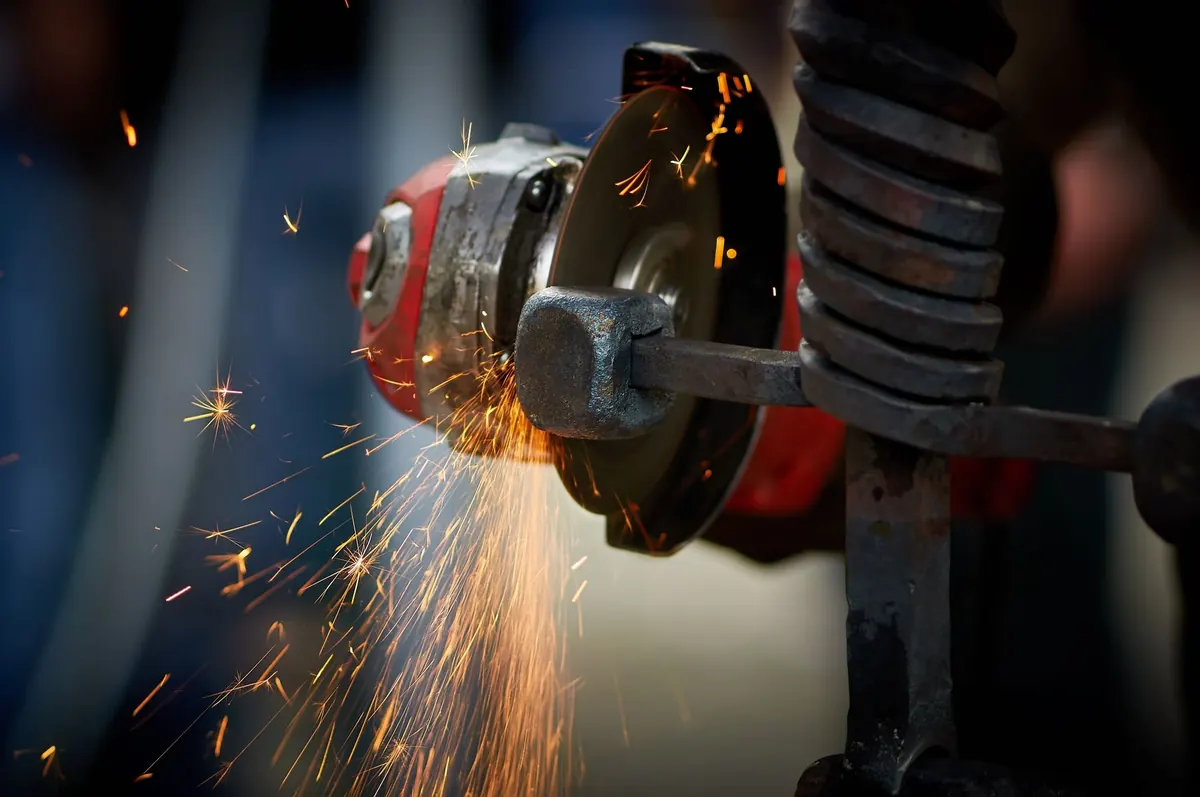
Press the steel against a grinding wheel and watch the stream of sparks. Iron burns; the carbon in the steel burns in small bursts along the way. More carbon means more bursts, more forks and a bushier stream. That is the entire principle. You are not reading a number, you are judging a family — mild, medium or high carbon — and spotting the alloys that behave oddly.
Two habits separate a useful test from guesswork. Work in shade or low light, because in bright daylight every spark reads as the same white blur. And always compare against steel you already know. Keep a labelled reference set: a short bar of known mild steel, an old file, a piece of known spring. Grind each one until you can recognise its signature, then grind the mystery piece beside it. Comparison beats memory every time.
Grind a clean patch first to get through rust, paint or scale, and keep your head back. Wear eye protection, use a dust mask on anything with an unknown coating, tie back long hair and loose sleeves, and keep bare hands or gloves well clear of the wheel — loose fabric near a grinder is how people get pulled in.
Reading the stream
Hold the workpiece low, angled slightly downwards, so the sparks stream across your field of view rather than at your face. What you are looking for:
- Mild steel, low carbon: long, straight, straw-yellow to orange streaks. Few forks, few bursts. The stream carries a surprising distance before it fades.
- Medium carbon: still fairly long, but with small forks toward the end of each streak.
- High carbon — files, springs, bearing races: shorter, brighter and bushy, with star-like bursts and feathery forks all along the stream.
- Cast iron: short, dull, reddish sparks that barely leave the wheel, often in broken dotted lines.
- Stainless and other chrome or nickel-heavy steels: short, dark orange and sparse. Some austenitic grades give you almost nothing at all.
- Manganese steel: bright white with heavy forking.
- Aluminium, brass, copper and bronze: no sparks whatever. They simply smear the wheel, so clean it before you test steel again.
Treat this as a family identification, not a grade certificate. Two different high-carbon steels can spark similarly, and a heavily alloyed steel can fool you. The point is to decide whether a piece is worth a heat-treatment trial or belongs in the gate-fitting pile.
The magnet tells you one thing
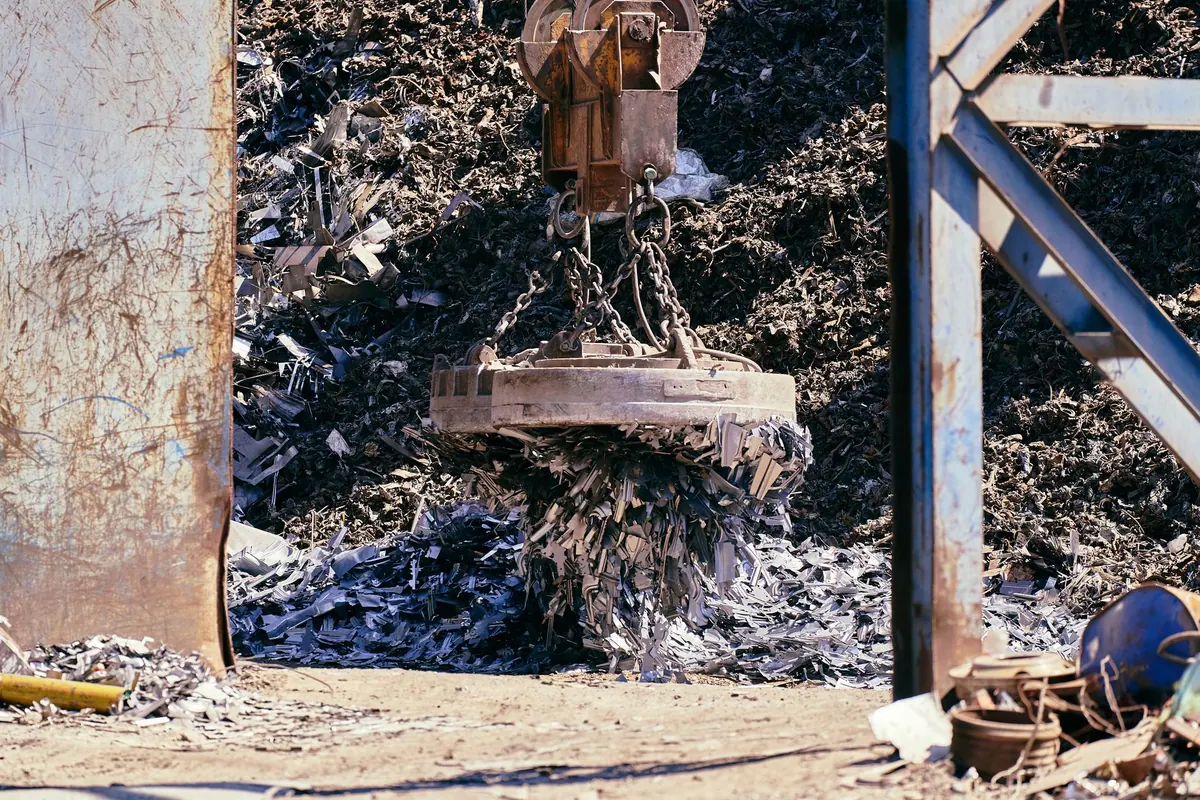
A magnet sticks to most carbon and low-alloy steels — including plenty that will never harden. It will barely tug at 300-series stainless such as 304 or 316, and it drops off austenitic manganese steel. It ignores aluminium, brass, copper and bronze completely.
So a magnet cannot confirm blade steel, and a piece that grabs hard is not automatically good. What it does tell you is that you are probably holding iron or steel rather than something that will gum up your wheel, and that you are probably not looking at a heavily austenitic alloy. That is worth knowing. A magnetic stainless, for instance, is likely to be a ferritic or martensitic grade with some hardenability; a non-magnetic one is better suited to fittings and guards than to an edge.
Three more bench tests
The file test
A sharp file skates across hardened steel and bites into soft steel. Try it on a clean edge or corner, not on a spot that has been hammered or bent, since work hardening can fool you. If the file bites, the piece is not usable as it stands, but it may still harden if there is enough carbon in it.
The heat-treatment coupon
This is the only test that tells you the truth about a specific piece. Cut a small offcut, heat it to just past non-magnetic, quench it in your usual oil, then file it. If the file skates, you have a hardenable steel. If it bites, try water or brine on another coupon — some shallow-hardening steels need a faster quench. Temper the hardened coupon in the oven, snap it in the vice and look at the break: fine, even grey means you were close; coarse and crumbly means it got too hot.
Sound and feel
Tap a thin section. High-carbon steel tends to ring; mild steel thuds. It is not reliable on its own, but it is a useful confirmation when it agrees with your sparks.
Mark it, or lose it
Chalk rubs off, marking dye smears and paint pen fades in sunlight. Punch a simple dot code instead: one dot for known mild, two for spring steel, three for file or high-carbon, a cross for unknown and unhardenable. A wire tag through a drilled hole works well for awkward shapes, and a notebook or a photograph of the pile keeps the details you will otherwise forget within a fortnight.
One safety point worth repeating: do not grind, forge or weld anything galvanised, chromed, cadmium-plated or coated in old lead paint. The fumes from those coatings are genuinely harmful, and metal fume fever is a miserable way to spend an evening. Strip coatings outdoors with proper respiratory protection, or set the piece aside. If you are unsure what a coating is, do not burn it off to find out — work with good ventilation and appropriate protection, and take proper advice when a material is questionable.
A routine worth repeating
None of this takes long once it becomes habit. When a new piece of scrap lands on the bench:
- Look at it and guess what it used to do.
- Magnet it to rule out the non-ferrous and the austenitic.
- Grind a clean patch and compare the sparks against your reference set.
- If it looks like spring or high carbon, cut a coupon and run a quench-and-file test.
- Punch your code on it and store it in the right pile.
Five minutes of sorting saves an hour of forging, and it means that when you reach for a piece of steel for a blade, you already know what it is likely to do. That is the difference between a workshop that accumulates scrap and one that accumulates material.
Photo: igovar igovar / Pexels